


Researchers at Zhengzhou University (ZZU) have made significant progress in developing a new oral cancer vaccine platform, offering a programmable, scalable, and safe technological pathway for next-generation needle-free tumor immunotherapy.
Oral therapeutic cancer vaccines present advantages such as non-invasiveness and the ability to stimulate systemic and mucosal immunity. However, ensuring stable antigen delivery across the intestinal barrier has long been a major challenge.
To address this, the team engineered a probiotic-based oral vaccine platform, BacOR-Fn-T+phiX174. Using synthetic biology, the modified bacteria serve as both a production factory and a delivery vehicle for ferritin-based nanovaccines. An inducible lysis module enables the controlled release of vaccine particles within the intestine.
The released nanoparticles are efficiently taken up by mucosal immune cells, stimulating strong CD8+ and CD4+ T-cell responses and enhancing B-cell and macrophage activity. In mouse models of melanoma, the vaccine demonstrated therapeutic efficacy against both lung metastasis and subcutaneous tumors while establishing lasting immune memory, without disrupting systemic or mucosal balance.
Published in the journal Nature Communications under the title "Probiotic-based oral vaccine mucosal delivery system enabling genetically encoded dual-antigen arrays", the study was co-corresponding authored by Associate Professor Jiang Bing and Academician Yan Xiyun.
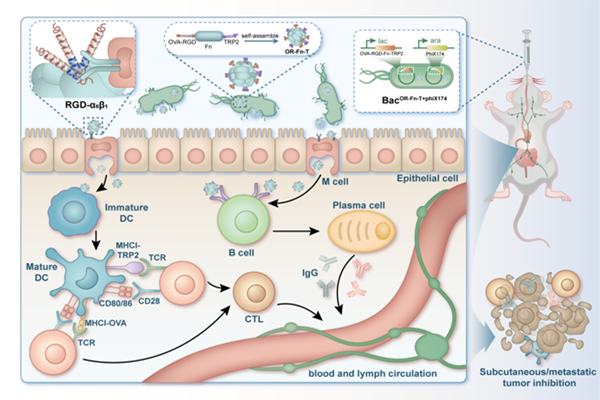
Schematic diagram of an engineered probiotic-based oral vaccine system for tumor immunotherapy. [Photo/zzu.edu.cn]