


A research team led by Professor Li Fuguang and Yang Zhao'en from Zhengzhou University's (ZZU) School of Agriculture and Biomanufacturing has reconstructed the evolutionary roadmap of upland cotton.
The study clarifies how large-scale chromosomal variations shaped genetic diversity and environmental adaptation and reveals the genetic architecture underlying key agronomic traits such as fiber quality. Published in Nature Genetics, the findings provide important theoretical and technical support for overcoming genetic homogenization in cotton breeding.
Modern cotton cultivation faces significant challenges due to reduced genetic diversity, climate extremes, and pest pressures. To address this, the team analyzed 107 representative upland cotton accessions to construct a super-pan-genome. They identified a major translocation event between chromosomes A03 and A09 that significantly influenced population differentiation and regional adaptation.
The research delineated a three-stage domestication and dispersal route for upland cotton. It also confirmed gene flow between upland and sea island cotton in certain regions, which may have contributed to adaptive traits in modern cultivars. Additionally, the team discovered 69 structural variants associated with fiber quality and identified a novel locus linked to Verticillium wilt resistance.
These results elucidate how structural variations have driven cotton evolution and offer a genomic foundation for developing new cotton varieties with enhanced resilience, yield, and fiber quality.
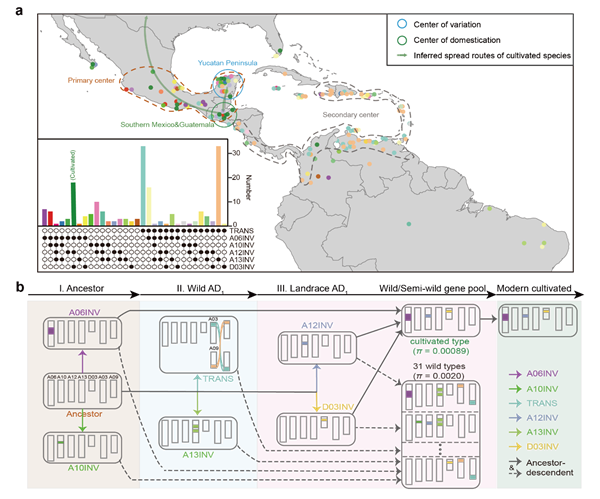
The evolutionary trajectory of upland cotton along the coasts of Central America and the Caribbean. [Photo/zzu.edu.cn]