


Researchers from Zhengzhou University's (ZZU) School of Archaeology and Cultural Heritage have published new findings on Ohalo II, a well-preserved submerged prehistoric site in Israel dating back approximately 23,000 years. The study offers fresh insights into the daily activities and site formation processes of early fisher-hunter-gatherer communities during a critical transitional period.
Using a multi-method approach combining experimental archaeology and contextual taphonomic analysis, the team examined stone tool assemblages from different areas of the camp. They found that the lithic artifacts, primarily small blades and microliths, were used extensively for a variety of purposes, including projectile weapons and in processing activities. High breakage rates were attributed to both human use and natural post-depositional processes.
The analysis revealed distinct activity zones within the camp. A brush hut floor served as a multi-purpose living area that experienced heavy trampling and burning, while an open hearth was central to tool maintenance and woodworking. A small ash pit was identified as a secondary refuse deposit. This spatial reconstruction provides a clearer picture of the camp's organization.
Published in Archaeological and Anthropological Sciences, the study was led by Liu Jiying from ZZU as first and corresponding author, in collaboration with scholars from Zhejiang University and the University of Haifa in Israel.
This international research project underscores the school's commitment to global academic collaboration and interdisciplinary innovation in archaeology. ZZU plans to further expand such partnerships to enhance its contribution to the study of human cultural heritage and promote cross-cultural academic exchange.
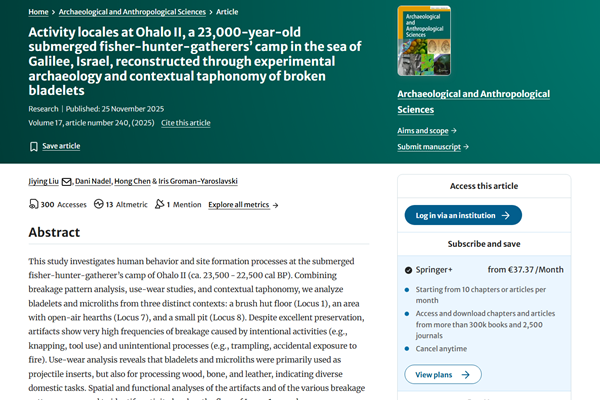
The study is published in Archaeological and Anthropological Sciences. [Photo/zzu.edu.cn]