


Professor Wang Meiyun from Zhengzhou University (ZZU), serving as co-corresponding author, has published a landmark study in journal Nature that identifies a core dysfunctional brain network in Parkinson's disease. The research defines a "somato-cognitive action network (SCAN)" — a circuit involving specific cortical areas and deep brain nuclei — whose abnormal connectivity is fundamentally linked to the motor and cognitive symptoms of Parkinson's disease.
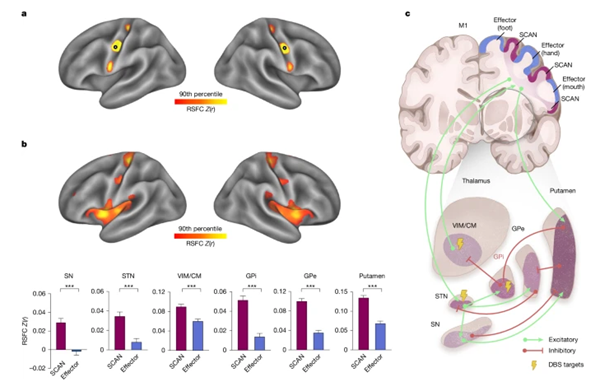
Cortical functional connectivity of six subcortical regions critical in Parkinson's disease. [Photo/zzu.edu.cn]
This discovery offers a new framework for understanding Parkinson's disease, which affects over 5 million people in China alone. Current treatments, such as medication and invasive deep brain stimulation, are hampered by strong side effects, high costs, and lack of access
Building on the SCAN model, the research team developed a novel non-invasive therapy using personalized transcranial magnetic stimulation guided by individual SCAN mapping. In trials, this targeted approach demonstrated a symptom improvement more than double that of stimulation aimed at traditional motor areas alone.
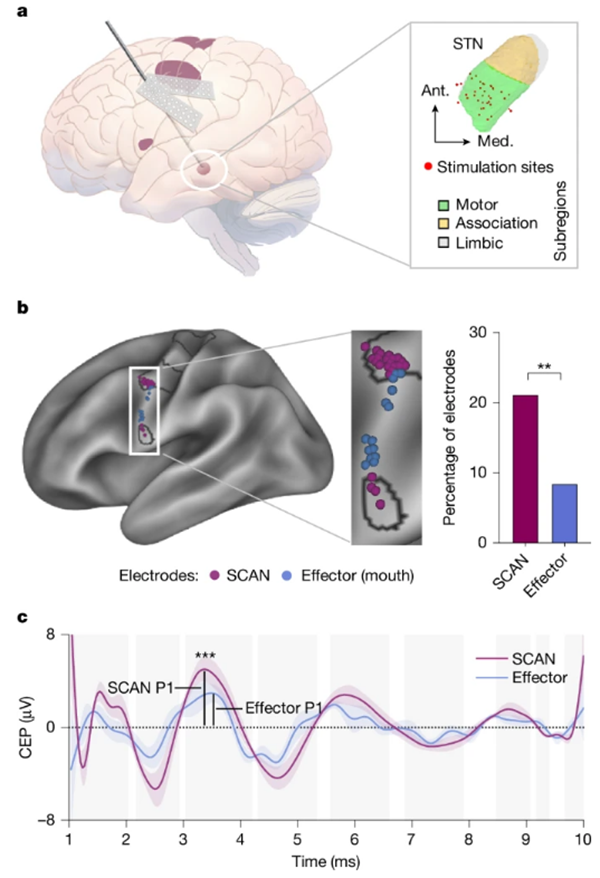
DBS-evoked cortical responses in the SCAN. [Photo/zzu.edu.cn]
The study, a collaboration between Prof Wang and Prof Liu Hesheng from Changping Laboratory, along with researchers from Tsinghua University, Harvard Medical School, and the University of Washington, is the first in the radiology field from the Chinese mainland to be published in Nature. It provides a precise, safe, and effective non-invasive therapeutic strategy, marking a significant step forward in the diagnosis and treatment of Parkinson's disease.
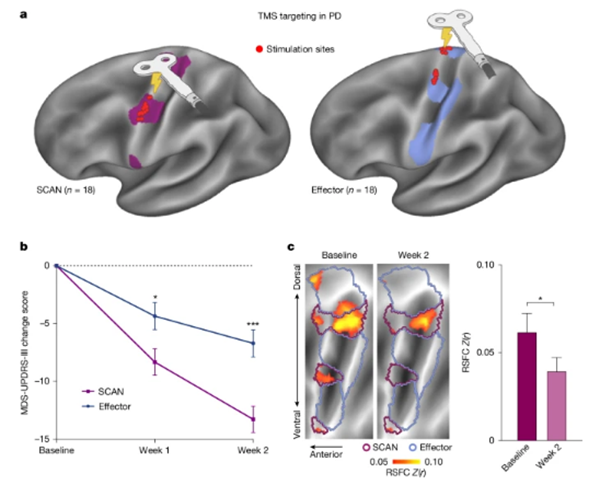
TMS targeting the SCAN versus effector-specific motor regions. [Photo/zzu.edu.cn]