


A research team from Zhengzhou University (ZZU) has revealed the atomic-scale mechanism driving the size-dependent elastic softening of nanodiamonds. The findings, published in Physical Review X, challenge the conventional view of diamond as a purely hard and brittle material.
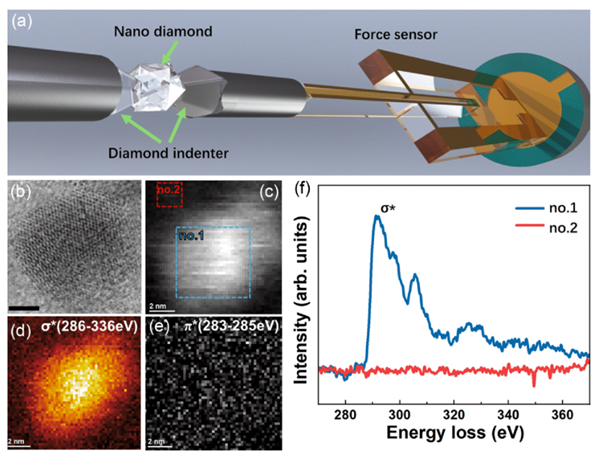
Measurement system and sample characterization. [Photo/zzu.edu.cn]
Diamond is known for its exceptional hardness and thermal conductivity. However, while bulk diamond typically undergoes brittle fracture under minimal elastic strain, recent studies have shown that nanoscale diamonds can exhibit significant reversible elastic deformation. The underlying physical mechanism has remained a key scientific question.
Using advanced in-situ transmission electron microscopy combined with theoretical simulations, the team systematically investigated the elastic behavior of nanodiamonds ranging from approximately 13 nm down to 4 nm. They observed a monotonic decrease in the effective Young's modulus from about 1000 GPa to 700 GPa as particle size decreased, revealing a clear size-dependent softening effect.
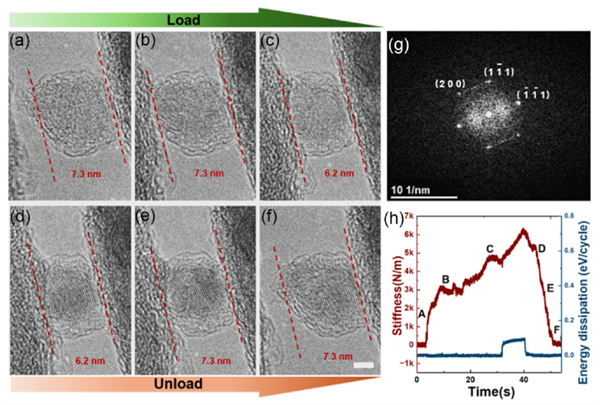
Measurement of the mechanical properties of the nanodiamond. [Photo/zzu.edu.cn]
Surprisingly, this softening does not originate from the outermost surface atomic layer, which remains relatively stiff. Instead, the key lies in the subsurface interfacial region between the surface and the crystalline core. In this transition zone, atomic bonds are elongated and local charge density is reduced, forming a mechanically compliant interface layer.
The discovery provides a new physical picture for understanding how inherently brittle materials can exhibit remarkable flexibility at the nanoscale. It also offers a novel strategy for tuning the mechanical properties of nanomaterials through interface engineering, with potential applications in nanomechanical resonators, quantum devices, and thermal management systems.
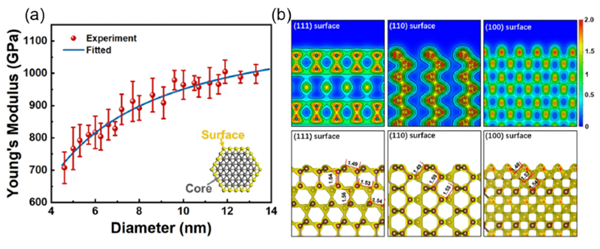
Size dependence Young's modulus of nanodiamond and first principles simulations of diamond surface. [Photo/zzu.edu.cn]