


A research team led by Professor Xu Qun from the Henan Advanced Technology Institute at Zhengzhou University (ZZU) has made a breakthrough in quantum materials. By employing supercritical carbon dioxide (SC CO2), the team successfully induced a novel monoclinic phase in the quantum paraelectric material KTaO3 (KTO) and achieved a spin glass state. The work is published in Science Advances.
KTO exhibits strong spin-orbit coupling and a robust cubic perovskite structure even near absolute zero, making it difficult to introduce internal magnetism. Traditional high-pressure methods can induce phase transitions, but the material reverts once the pressure is released.
The team used SC CO2 as a unique force field to break the inversion symmetry of KTO, stabilizing a previously unreported monoclinic phase. This new phase not only gave rise to spontaneous magnetic moments but also generated a spin glass state: strong ferromagnetic coupling on certain exposed crystal planes coexists with strong antiferromagnetism inside, leading to interface frustration.
The researchers confirmed that oxygen vacancy concentration did not increase after treatment, ruling out vacancy-induced magnetism. Spectroscopic analyses revealed a reduced average valence state of tantalum and elongated Ta-O bonds, along with a new phonon mode indicating the monoclinic distortion.
This work provides a new strategy for engineering metastable phases in quantum materials and opens up new possibilities for developing future spintronic devices.
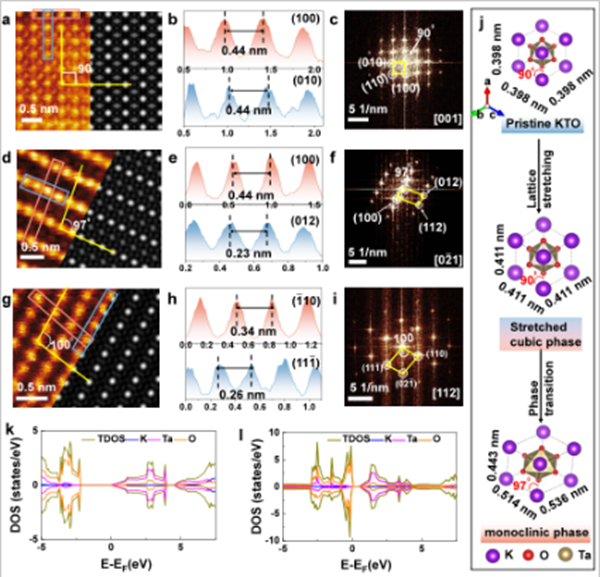
Atomic-scale structural analysis and simulation of monoclinic KTO. [Photo/zzu.edu.cn]
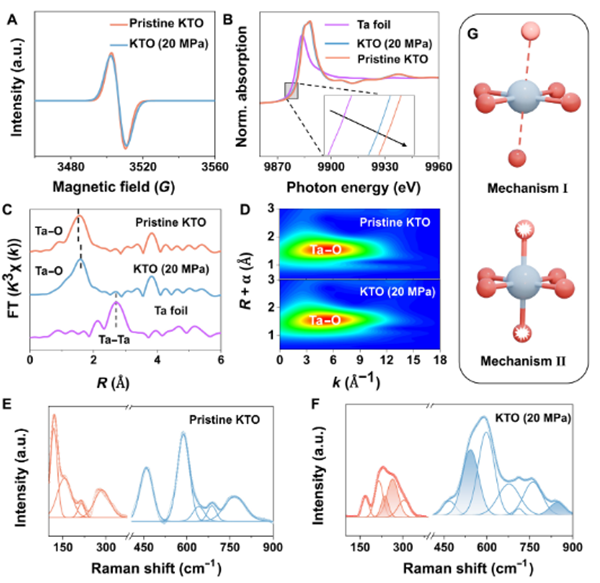
Spectroscopic decoupling of the monoclinic phase and oxygen vacancies (Ov). [Photo/zzu.edu.cn]
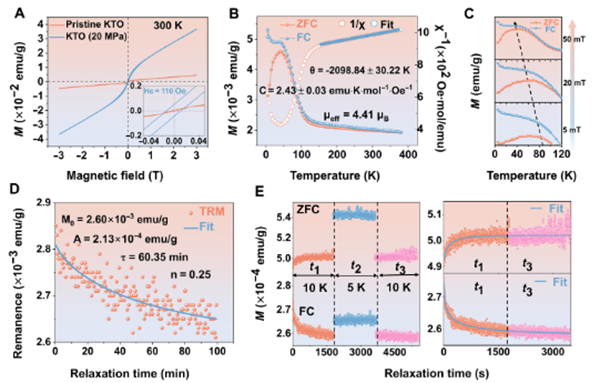
Evidence for a SG induced by the monoclinic phase. [Photo/zzu.edu.cn]