


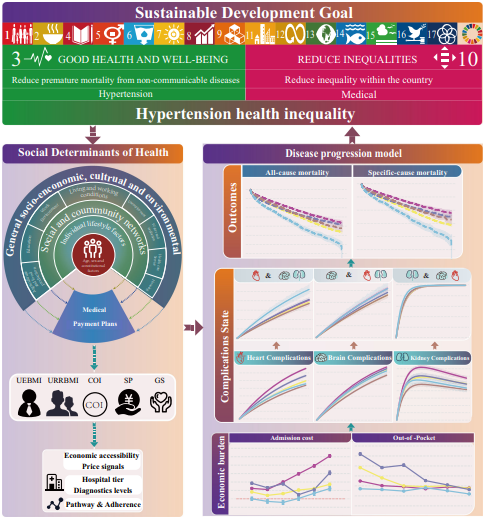
A conceptual framework for plan-related inequalities in hypertension. [Photo/zzu.edu.cn]
A research team led by Professor Wu Jian from Zhengzhou University's (ZZU) School of Public Health, in collaboration with Professor Guo Zhiping from Fuwai Central China Cardiovascular Hospital, has published a study in the journal Nature Communications on health disparities among hypertensive patients in China. The study analyzed data from 4.67 million patients and 8 million hospital records in Henan province between 2019 and 2024.
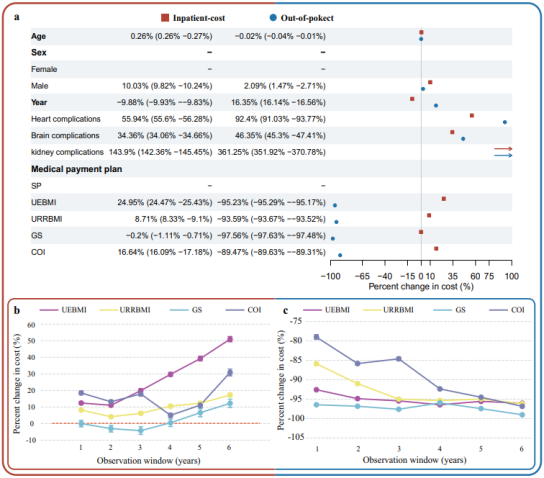
Associations of medical payment plans with economic burden. [Photo/zzu.edu.cn]
The findings reveal significant inequalities related to medical payment methods. While patients with medical insurance had higher total hospitalization costs compared to self-paying patients, their out-of-pocket expenses were substantially lower — by 89 percent to 97 percent. However, reduced personal costs did not always translate to better health outcomes. Patients covered by employee-based insurance had a 28 percent lower risk of all-cause mortality, while those on government-assisted or medical aid plans had a 33 percent higher risk, despite having access to coverage.
The study highlights a complex chain linking payment schemes, financial burden, disease progression, and survival. Vulnerable populations receiving government assistance often face poorer health outcomes, indicating that cost protection alone is not sufficient to ensure equitable access to effective care.
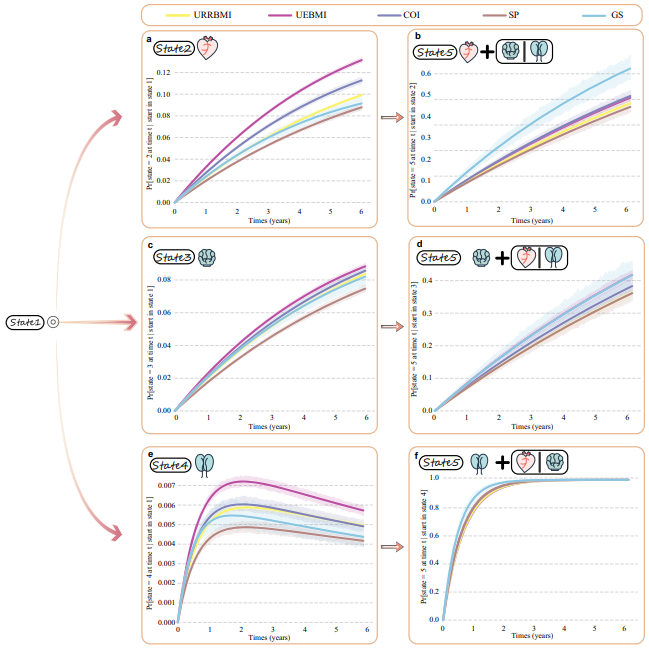
Modeled transition probabilities across medical payment plans. [Photo/zzu.edu.cn]
This research provides valuable evidence on how payment plans affect both costs and clinical outcomes, offering insights for designing more equitable health insurance policies in China.