


A research team from Zhengzhou University's School of Physics has made significant progress in mid-infrared position detection and trajectory tracking. The group achieved wafer-scale, low-temperature in-situ fabrication of two-dimensional telluride semimetal films and developed a high-performance mid-infrared position-sensitive detector (PSD) with in-sensor perceptual compression. The work has been published in the journal Science Advances.
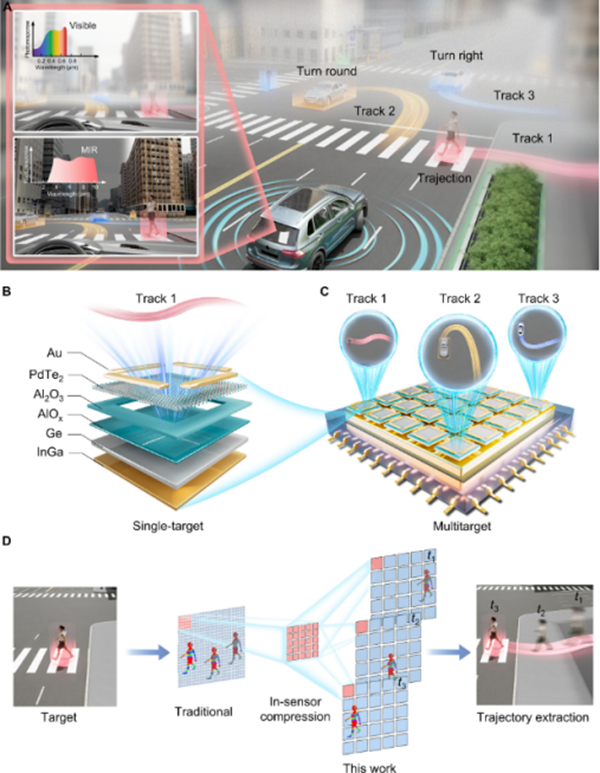
2D semimetal-based MIR PSD for intelligent driving applications and in-sensor compression. [Photo/zzu.edu.cn]
Real-time motion tracking is essential for autonomous navigation, intelligent driving, and security systems. However, current machine vision systems rely on high-pixel sensors and complex neural networks, requiring substantial computing power that limits their use on resource-constrained platforms. Position-sensitive detectors offer a simpler alternative by converting light spot positions directly into electrical signals, but traditional PSDs operate mainly in visible and near-infrared bands, with limited performance in fog, smoke, or darkness.
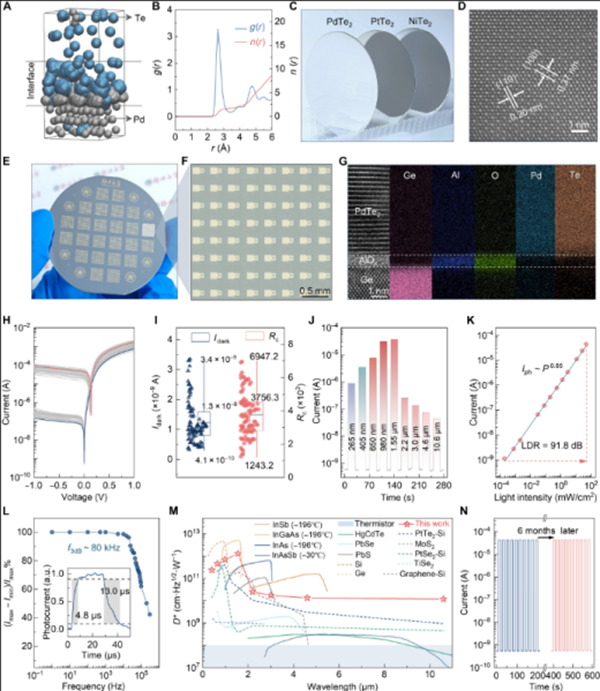
Low-temperature preparation and monolithic integration of 2D semimetals for MIR photodetection. [Photo/zzu.edu.cn]
To address this, the team used a low-temperature in-situ metal conversion process to fabricate 2D semimetal thin films on 2-inch Ge wafers, compatible with standard CMOS manufacturing. Through heterojunction interface engineering, the device achieved broadband mid-infrared detection extending to 10.6 μm at room temperature, filling a gap in this spectral range. Key metrics include a specific detectivity exceeding 1010 cmHz1/2W-1, position sensitivity of 91.6 mV/mm, and nonlinearity as low as 5.1 percent, enabling real-time trajectory tracking with 9.7 μm precision.
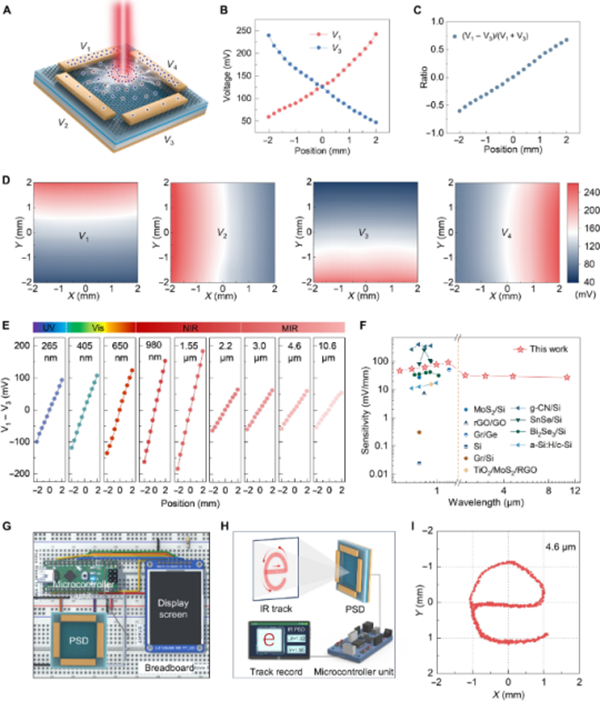
Photoelectric characteristics and IR light trajectory tracking demonstration of PdTe2/Ge PSD. [Photo/zzu.edu.cn]
The team also built a 5×5 PSD array that reduces raw data volume by 400 times and supports parallel tracking of multiple targets with 95 percent recognition accuracy, providing a new hardware solution for low-power intelligent infrared sensing in complex environments.